
SDG 4 | Quality Education
As the country’s oldest national university, the University of Mauritius is committed to inclusive, equitable and quality education for all. Beyond its undergraduate and postgraduate programmes, UoM opens its doors to the wider community through public lectures, short courses, outreach to schools and lifelong learning opportunities. The University also supports the training of professionals, and works to widen access for higher education. This page presents evidence of UoM’s contribution to quality education.
4.3 Lifelong Learning Measures
The University of Mauritius provides free access to educational resources for people who are not enrolled at the University, in line with its commitment to inclusive, technology-enabled education and lifelong learning.
UoM publishes OERs through its openly accessible online repository, free of charge and without registration. In 2025, new self-paced learning units were released, including Introduction to Digital Literacy (May 2025) and Networking Essentials (August 2025), covering digital competencies, computer networks and networking protocols. This work is reinforced by the UNESCO Chair and the Commonwealth of Learning Chair in Inclusive Educational Technologies, established at UoM during the period, which promote OERs, micro-credentials and flexible learning pathways, particularly for vulnerable groups.
Under an MoU with the Ministry of Public Service, Administrative and Institutional Reforms, the Library gives public officers both online access (e-books, journals, databases) and physical access to its facilities, supporting continuous learning across the public sector.
The University of Mauritius also extends free access to knowledge to people who are not its students by making the outputs of major public research events openly available. In April 2025, UoM hosted the opening and two days of the National Research Week 2025 (14–18 April), under the theme “Uniting Research, Industry and Innovation”. The week brought together researchers, higher education institutions, NGOs, industry, government and civil society for keynotes, themed sessions on sustainability, green technologies, the circular economy and the blue economy, and presentations of current Mauritian research. To ensure this knowledge reaches beyond those who attended, the abstracts and presentations were published in the Proceedings of the National Research Week 2025. These are hosted on the University’s public website and are free to read and download without registration, giving the general public, practitioners and learners lasting open access to the research shared during the week.
The University of Mauritius (UoM) regularly hosts educational events that are open to the general public and free to attend. These events share research findings and support lifelong learning through dialogue with practitioners, community organisations, policymakers and members of the public. In 2025, the University’s 60th anniversary year, they covered:
• biodiversity conservation;
• gender-based violence;
• social work and wellbeing;
• African history and justice;
• constitutional reform;
• food literacy;
• renewable energy;
• sustainable development.
National Dissemination Workshop on Street Harassment (02 December 2025). This public workshop presented UoM research findings to national institutions, civil society and members of the public, who were invited to attend and contribute to the discussion on preventing gender-based violence.
Public lecture: “Constitutionalism in Mauritius” (23 September 2025). UoM hosted a public lecture and panel discussion by Professor Tarun Khaitan, Chair of Public Law at the London School of Economics. It was organised with the Mauritius LSE Society Trust Fund, the National Human Rights Commission and the UoM Law Society and Alumni. The lecture covered constitutional principles, the role of courts in advancing social and environmental rights, and electoral reform options. The President of the Republic was among those attending.
Launch of the Food Literacy and Sustainable Nutrition (FOLSUN) Initiative (25 September 2025). The Faculty of Agriculture launched a two-year public education initiative to promote informed food choices and sustainable practices among individuals, communities and enterprises. Professor William Chen Wei Ning of Nanyang Technological University, Singapore, gave the keynote. Public and private sector partners, NGO representatives and the Minister of Agro-Industry, Food Security, Blue Economy and Fisheries attended.
The University of Mauritius (UoM) offers vocational training and short courses to the general public, to working professionals and to organisations outside the University. These let people who are not enrolled in UoM degree programmes gain practical, job-relevant skills and recognised certificates. UoM is registered as a training institution with the Mauritius Qualifications Authority (MQA). It offers non-award short courses to the public and designs tailor-made courses commissioned by employers.
Professional Development Programmes (PDPs). The Centre for Innovative and Lifelong Learning (CILL), based at UoM’s Ébène campus, offers short, skills-based PDPs for working professionals. Participants gain new competencies and recognised credentials, and they earn academic credits towards a UoM Postgraduate Certificate . The programmes are delivered online through UoM’s partnership with Coursera, with tutorials and assessment by UoM academics. Through these initiatives, staff, students and “members of the wider community gained access to internationally recognised courses and industry-relevant skills in emerging fields”. PDPs offered in 2024/25 included.
• Financial Management (LC015);
• Project Management (LC016);
• Strategic Leadership and Management Skills for Middle Managers and Leaders (LC017);
• Teaching and Learning with AI (LC023);
• Ayurveda and Nutrition (LC019);
• Working with Youth (LC028), with the Faculty of Social Sciences and Humanities and the Mauritius Research and Innovation Council;
• Youth and Sustainable Development (LC029), with the same partners.
Lir ek Ekrir Kreol Morisien. This certificated programme teaches reading and writing in Kreol Morisien, the national language of Mauritius. UoM launched it in 2022 with the Akademi Kreol Repiblik Moris (AKRM), in partnership with the Mauritius Institute of Education and the Creole Speaking Union. It is open to the general public. Learners take a 20-hour foundation course, then can choose one of three 20-hour options:
• general public (creative writing and Mauritian literature);
• administration;
• media and communication.
Participants therefore complete 20 or 40 hours. The 2025 cohort had about 50 participants of different ages and backgrounds, from young professionals to retirees. The Media Trust sponsored journalists to attend, and AKRM partly sponsored the course. A hybrid format let members of the Mauritian diaspora take part. Certificates were presented to the fourth cohort on 25 October 2025 at UoM’s Réduit campus.
Advanced Food Processing (July 2025). The Faculty of Agriculture, with the farmers’ network F.A.L.C.O.N. and support from the National Social Inclusion Foundation (NSIF), delivered a five-day hands-on course to 35 participants from across Mauritius. It covered food processing skills, food quality and food safety. The course ended with a certificate ceremony on 23 July 2025, attended by the President of the Republic and the Minister of Agro-Industry, Food Security, Blue Economy and Fisheries.
Together, these programmes extend UoM’s teaching beyond its degree programmes and give working adults, community workers and employers access to recognised, practical training.
The University of Mauritius (UoM) takes education beyond its campuses through outreach to schools and the wider community. Academics, researchers and students run science activities, talks and workshops for secondary school students and the public. The aims are to spark curiosity, encourage young people, especially girls, to consider STEM careers, and raise awareness of sustainability, health and Mauritius’s natural resources. UoM also supports the national school system through teacher training and its role in the national Kreol Morisien examinations.
UoM took part in outreach events beyond its campuses:
• National Science Week 2025, Côte d’Or National Sports Complex (10–14 March 2025). The Department of Physics ran interactive demonstrations, hands-on experiments and outreach activities “aimed at promoting scientific curiosity and engagement among students and the wider public.
• Phoenix State Secondary School (27 March 2025). Dr S. D. Biranjia-Hurdoyal of the Faculty of Medicine and Health Sciences gave a talk at the school.
• Phoenix State Secondary School, same day. The Centre for Biomedical and Biomaterials Research (CBBR) ran science outreach for Grade 7 students. Using hands-on demonstrations and discussion, it showed how local plants, marine organisms and agricultural products support health, food security, economic development and scientific innovation, and encouraged students to protect and responsibly use the island’s biodiversity.
Together, these activities bring UoM’s expertise directly into schools and communities. They widen access to science and learning for young people, support teachers, and strengthen links between the University and the society it serves.
The University of Mauritius (UoM) is committed to making its educational activities, including lifelong learning, continuing education and community learning opportunities, accessible to all members of society. Access is provided without discrimination on any ground, including ethnicity, religion, disability, nationality and gender.
This commitment is grounded in the University of Mauritius Act 1971 (Amended 2023). It is also put into practice through the University of Mauritius Regulations, which were in force throughout the 2024/2025 academic year and also through initiatives aimed at opening access to lifelong learning.
The University of Mauritius Act 1971 (Amended 2023)
Section 6 of the University of Mauritius Act 1971(Amended 2023), available at (https://www.uom.ac.mu/images/FILES/AboutUs/UoMAct1971.pdf) is as follows:
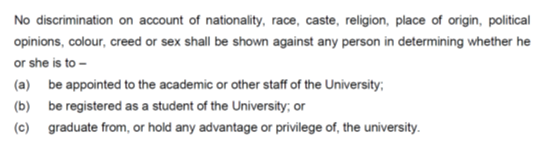
This is a statutory obligation. It binds the University in all its educational activities and in deciding who may take part in them.
Furthermore, the Act explicitly extends the University’s educational mission to the wider public:
- Extract of Section 7(2)(e):

It empowers the University to provide instruction for such persons, whether members of the University or not, as it thinks fit, and to advance and disseminate knowledge.
- Extract of Section 7(2)(f):

It empowers the University to provide lectures and instruction for persons who are not members of the University, and to grant Diplomas and Certificates.
- Extract of Section 4:
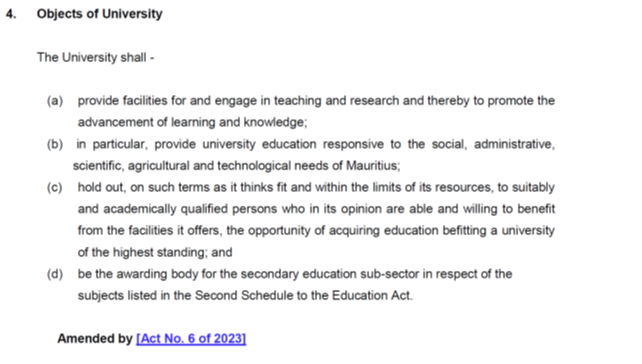
It requires the University to provide education responsive to the social, administrative, scientific, agricultural and technological needs of Mauritius.
Together, these provisions give UoM a legal mandate for lifelong learning open to the general public.